Why Cats Get Hairballs – And How to Prevent Them
My cat produced a hairball on my laptop keyboard at 7am on a Tuesday. The sound alone was enough to wake the neighbors. I cleaned it up, told myself it was fine, and did not think much more about it.
Then it happened three times in one week.
That is when I started actually looking into how to prevent cat hairballs – not just manage the cleanup. What I found was more useful than anything on the back of a hairball treat packet.
How to prevent cat hairballs comes down to three things: reducing how much loose fur your cat swallows, supporting gut motility so hair passes through instead of accumulating, and knowing when the frequency has crossed from normal into something worth a vet visit.
What Actually Causes Hairballs in Cats
The medical term is trichobezoar. It sounds serious. Most of the time it is not.
Cats have backward-facing papillae on their tongues – the tiny hook-like structures that give a cat’s tongue its sandpaper texture. Those hooks are brilliant for cleaning fur but terrible for letting go of anything they catch. Loose hair gets trapped and swallowed almost involuntarily during grooming.
Most of that hair passes through the digestive system without issue. But when enough accumulates in the stomach, the cat vomits it out as a compacted, tube-shaped mass. That is a hairball.
According to Dr. Richard Goldstein at Cornell University, a frequency of once every one to two weeks is within the normal range for cats. More frequent than that is a symptom worth investigating – not just an inconvenience to clean up.
How Much Hairball Activity Is Too Much
Once a week is the upper edge of normal for most cats. Once every few days is not normal.
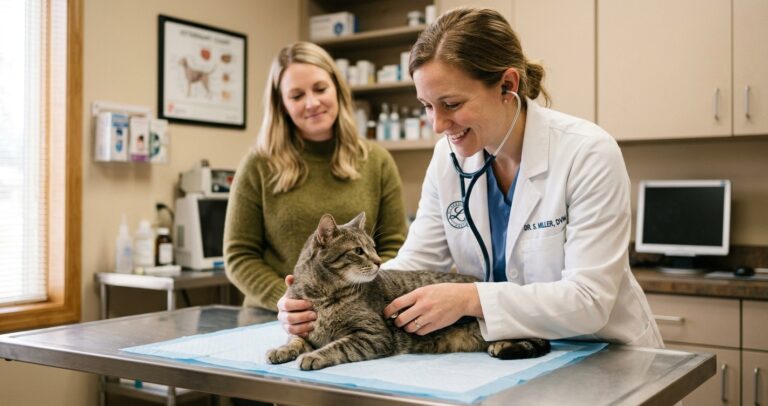
If your cat is retching repeatedly without producing anything, that is a different situation entirely and needs a vet visit promptly. A hairball that cannot be expelled can become a genuine obstruction.
Signs that go beyond normal hairball activity:
- Retching or gagging that produces nothing
- Lethargy combined with vomiting
- Loss of appetite lasting more than a day
- Distended or painful abdomen
- Any hairball activity in a kitten under 12 months
These are not hairball problems. These are vet problems.
How to Prevent Cat Hairballs – What Actually Works
Brush Your Cat More Often
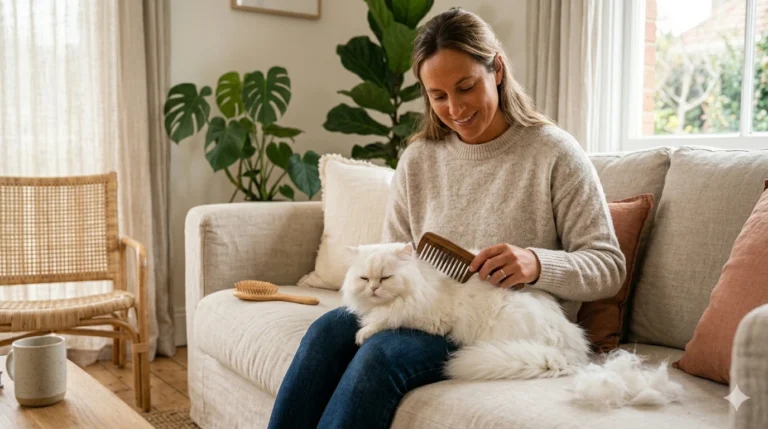
This is the single most effective thing you can do. Loose fur that you remove with a brush is fur your cat does not swallow.
Long-haired breeds like Persians, Maine Coons, and Himalayans benefit most from daily brushing. Short-haired cats can typically go every two to three days. During spring shedding season – when cats shed their heaviest – daily brushing for any breed makes a real difference in hairball frequency.
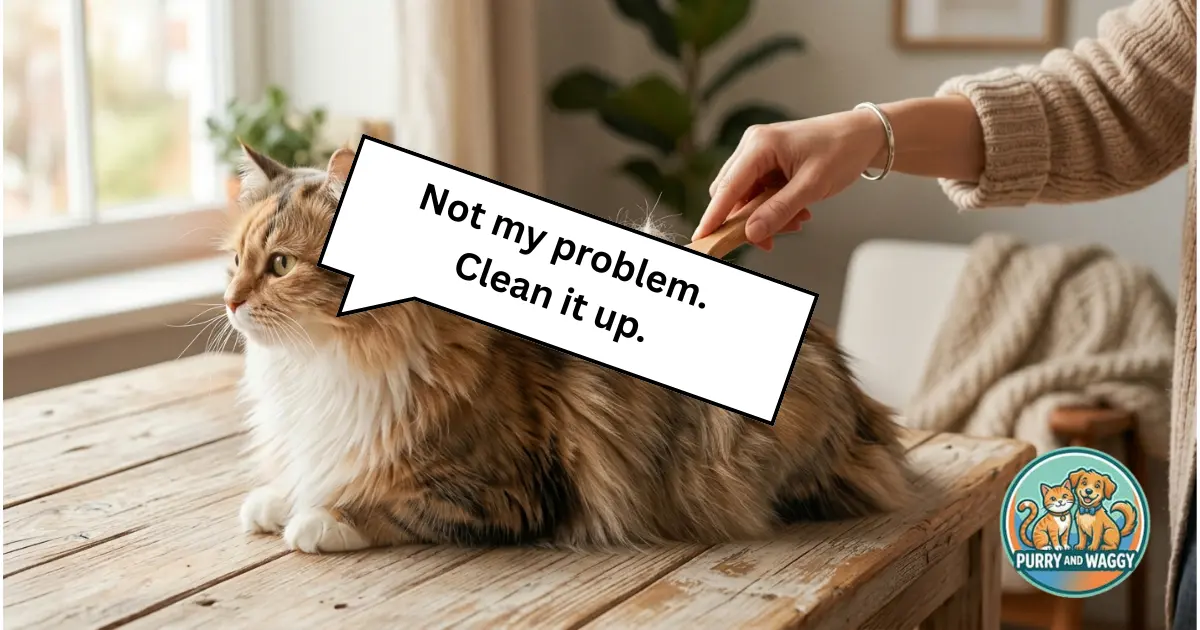
The correct order matters if your cat has any tangles: wide-tooth comb first to work through knots, dematting comb if needed, then a finishing brush like the Purry Self-Cleaning Brush to collect the loose surface fur. The Purry brush works well for this final step on tangle-free coats – it is not the right tool for mats or dense undercoat that has not been loosened first.
For a full grooming routine built around preventing tangles and keeping coat maintenance manageable, our guide on long-haired cat grooming covers the step-by-step process in detail.
Feed a Diet That Supports Gut Motility
Fiber is the dietary factor most directly linked to hairball prevention. It improves gut motility – the speed at which material moves through the digestive tract – so hair passes through before it can accumulate into a ball.
Some cats do well with a small amount of plain canned pumpkin added to food – not pumpkin pie filling. About a teaspoon mixed in is enough. The fiber content is genuinely useful and most cats tolerate it without complaint.
Dedicated hairball-formula cat foods typically contain increased fiber levels. They are not magic but they are not useless either.
Hydration matters too. Dehydrated cats have slower gut motility, which means hair sits in the stomach longer. If your cat eats primarily dry food, adding wet food to the rotation – or a cat water fountain to increase drinking – can help more than most owners expect.
Omega-3 fatty acids from fish oil also support coat health in a way that reduces shedding volume over time. Results take 6 to 8 weeks of consistent use to show up visibly. Our article on the best foods to reduce pet shedding covers which specific nutrients actually move the needle on coat health.
Use Hairball Remedies Carefully
Petroleum-based hairball gels like Laxatone work by lubricating the digestive tract so hair passes through more easily. They are widely available and most vets consider them safe for occasional use.
The key word is occasional. Texas A&M’s veterinary medicine department is clear that long-term daily use of lubricant laxatives should not be the first management strategy. They are for when other approaches are not enough – not as a permanent substitute for addressing the root cause.
Never use any OTC laxative product for your cat without confirming the dosage and frequency with your vet first. The safety margins are narrower than most packaging implies.
Consider Cat Grass
Cat grass – typically wheatgrass or barley grass – has a long reputation as a hairball remedy. The mechanism was studied using electron microscopy at the Animal Medical Center in New York. The conclusion was that the grass fibers help stimulate the gag reflex and expel accumulated hair, rather than preventing ingestion in the first place.
So cat grass does not reduce how much hair your cat swallows. It helps move what is already there.
It is safe, inexpensive, and most cats genuinely enjoy it. As one part of a broader approach it is worth having around.
Long-Haired Cats vs Short-Haired Cats
Long-haired breeds produce hairballs more frequently – that is just physics. More fur, more swallowing, more accumulation.
Persians and Himalayans are the highest-risk breeds because their coats are so dense and shed so heavily year-round. Maine Coons and Norwegian Forest Cats have heavy spring sheds that spike hairball frequency seasonally. Ragdolls fall somewhere in the middle.
Short-haired cats like Siamese and Bengals produce hairballs far less often. Some short-haired cats go months without one.
If you have a long-haired cat and hairballs are a consistent issue, the grooming frequency is almost always the first lever to pull. Brushing three to four times a week removes enough loose fur to make a measurable difference in how often hairballs occur.
What the Research Actually Says
The Cornell Feline Health Center is the most reliable source on this topic. Their position is that occasional hairballs are a normal feature of cat biology – not a health problem to eliminate.
The goal is not zero hairballs. The goal is infrequent hairballs combined with awareness of the signs that indicate something more serious.
Frequent vomiting in cats – whether hairball-related or not – deserves veterinary attention. Vomiting is not a normal baseline state for a healthy cat, even if the cause is benign.
Hairballs and Shedding Season
Hairball frequency spikes during spring shedding season for most cats with double-layer coats.
March through May is when cats shed their winter undercoat. A cat that produces one hairball every two weeks in January might produce one every few days in April if grooming frequency does not increase to compensate.
This is predictable and preventable. Increasing brush sessions from twice a week to daily during peak shed months keeps the ingestion volume manageable.
Our guide on dog and cat shedding season by month explains exactly when each breed’s heaviest shed periods fall so you can plan ahead rather than react.
FAQ: How to Prevent Cat Hairballs
How often is it normal for a cat to have hairballs?
Once every one to two weeks is within the normal range according to Cornell University’s Feline Health Center. Once every few days or more frequently than that is worth discussing with a vet. A cat that has never had hairballs and suddenly starts having them frequently also deserves a vet conversation.
What is the best way to prevent hairballs in cats?
Regular brushing is the most effective single intervention – it removes loose fur before your cat swallows it. Supporting gut motility through fiber and hydration is the second lever. Hairball gels and remedies are useful supplements but should not replace the root cause approach.
Does cat food help with hairballs?
Hairball-formula cat foods with increased fiber content can reduce frequency. They work by improving gut motility so hair passes through faster. They are not dramatically more effective than a high-quality regular diet combined with regular brushing.
Is it bad if my cat has a lot of hairballs?
More than once a week consistently is worth a vet visit. Retching without producing anything, lethargy, or loss of appetite combined with vomiting are signs that go beyond normal hairball activity and need professional attention promptly.
Can I give my cat olive oil for hairballs?
Some owners use a small amount of olive oil as a lubricant. It is not dangerous in small quantities but it is also not as effective as purpose-made hairball remedies and adds unnecessary fat calories to the diet. If you want to use a lubricant approach, ask your vet about appropriate products and dosing.
Do indoor cats get more hairballs than outdoor cats?
Indoor cats often groom more frequently due to boredom or lower activity levels, which can increase hair ingestion. They also shed more consistently year-round due to artificial lighting disrupting seasonal signals. Both factors can contribute to higher hairball frequency compared to outdoor cats.
The Tuesday Morning Lesson
Mochi’s laptop keyboard incident turned out to be a grooming frequency problem. I had been brushing her once a week and calling it good. She is a domestic longhair with a coat that needs more attention than that.
Three sessions a week, a teaspoon of pumpkin in her food twice a week, and a cat water fountain later – she went from multiple hairballs a week to roughly one every ten days.
Not zero. But normal.